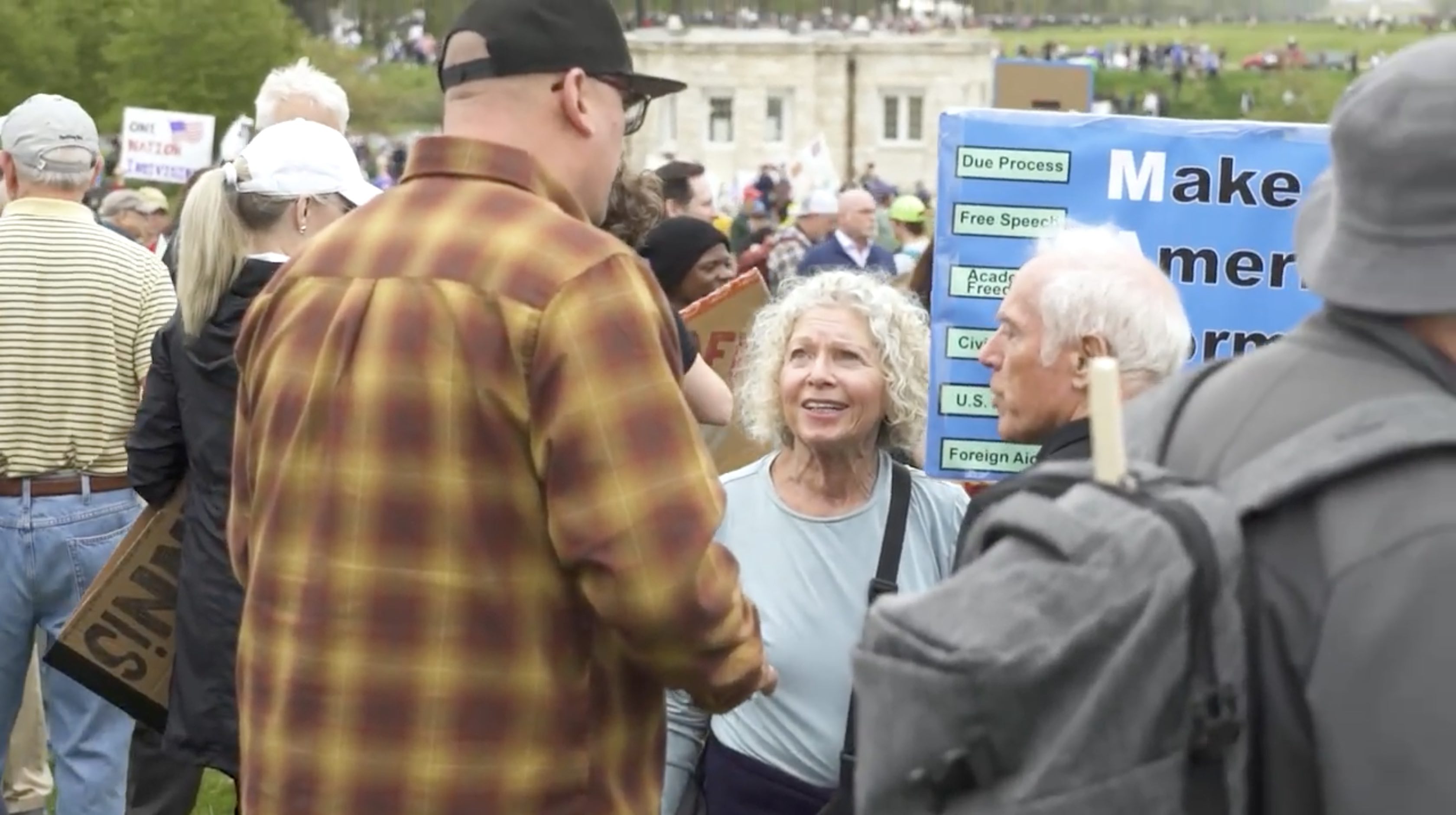

Jon Noyes uses questions about democracy at a women’s rights march to guide conversations toward a deeper issue: where human rights come from.
Transcript
Jon: Why is democracy important?
Protestor 1: There’s a Nazi in the crowd.
Jon: Can I ask you, why would you—why would you not introduce yourself and just call me a Nazi?
As you watch this video, notice I approach with a question. I ask about the sign and the value of democracy. And then I begin to press into the worldview question, Where do rights come from? Have you ever thought about that? What I’m trying to do is I’m trying to invite the people I’m talking to to think more deeply about whether rights are grounded in a government or if they’re grounded in something higher.
I love that everybody’s gathering here for democracy. Why is democracy important? I’m just merely trying to get some information.
Protestor 2: I was very happy to be growing up in this country.
Protestor 3: It’s everything that we stand for. It’s equal rights for people. It’s freedom for everybody.
Protestor 2: It’s free speech.
Protestor 3: This has always been a country that accepts and is happy to have immigrants. It’s a country made up of immigrants. So, you want to give all that up, you give up democracy.
Jon: Yeah, democracy is really, really important. Do you think those things—I think we probably agree on this, by the way. I’m not coming from an opposing view. I’m just saying, do you think—where do we get those rights from? Is it the government, or is there something higher than the government?
Notice again how I begin—not with a challenge, but with a question. This is something I do all the time. Why do I do it? It’s because it works. I ask a simple question: Why is democracy important? And then I let the conversation flow, gently guiding the conversation into deeper worldview issues with, you guessed it, another question: Where do rights come from?
And I think that this is a key thing to us understand because what I’m doing is I’m taking the issue beneath the issue, so to speak. I’m digging deeper. And people may say that they value freedom, they value equality, they value their rights, but if those things only come from the government, that means the government can take them away whenever the government decides to take them away. So, the key principle here is that true rights have to be grounded in something transcendent—something unchanging, something above any government—and that’s why even the American founders appealed to a Creator, not to Congress.
Now, keep in mind here, you’re not trying to win a fight. You’re inviting your conversation partner to think beyond the politics to the worldview beneath the politics. You see, if the government gives you your rights, government can take them away. But if God gives them to you, no one can touch them.
Protestor 1: He’s filming you, and you’re on mic.
Protestor 3: Are you kidding me?
Jon: Hey, can I ask you a question? Can I ask you, why would you not introduce yourself and just call me a Nazi? My name is Jon. Thank you.
I’m a pastor, and what I do is I specialize in worldview stuff, but I’m not a Nazi. I just want to know—I think that a lot of people here, we don’t understand where our rights come from. I think that we think it’s the government that gives us our rights, and I think that we’re given our rights by God.
Protestor 3: Our founding fathers of this country established how America would be and how America has always been. So, yeah, you don’t have to destroy that.
Jon: Yeah. I agree. It’s very, very special.
Protestor 2: You don’t have to believe in God to believe that people should have rights.
Jon: I mean, but if it’s the government who gives us rights, do you think the government can take our rights away, or do they remain even so?
Protestor 2: They can.
Jon: They can try.
Protestor 2: Well, they’ve done it a lot of other places, and they’re working on it here. So, clearly they can.
Jon: Do you guys believe in God at all?
Protestor 2: I went to 16 years of Catholic school.
Jon: Oh yeah. So, you had no choice. [LAUGHS]
It’s interesting because everybody’s carrying signs, but if you don’t want to talk to people disagreeing with you, why carry the signs?
You guys, I think you noticed that this moment shows why tactics matter so much, especially in emotionally charged conversations and areas. There’s a lot of emotions flying around where I was. Out of nowhere, someone calls me a Nazi, and it’s a completely false and absurd accusation, by the way, and this is what’s known as an ad hominem fallacy. Rather than engaging my question and the conversation, they attack my character. And when that happens, you have two choices. I mean, you can react emotionally, and I could retort and say, “Hey, oh yeah, well, your mother’s ugly, and she knows it.” Right? Or I can choose to stay calm. And as a Christian, I’m going to choose to stay calm because I have the truth. Remember, there’s no reason for me to get offended. So here, I stay calm. I introduce myself. I clarify that I’m simply here to have a thoughtful conversation. I think that this is exactly the Stand to Reason way. You know, don’t take the bait. Stay focused. Don’t defend yourself emotionally. There’s no need. And then keep gentle pressure for clarity and substance.
The goal here is to model how to have conversations that are both gracious and firm, even when you’re being falsely labeled. It can be difficult, but when you have a plan, it’s doable.
So, when people attack you instead of your argument, stay calm. The more gracious you are, the more their fallacy exposes itself.