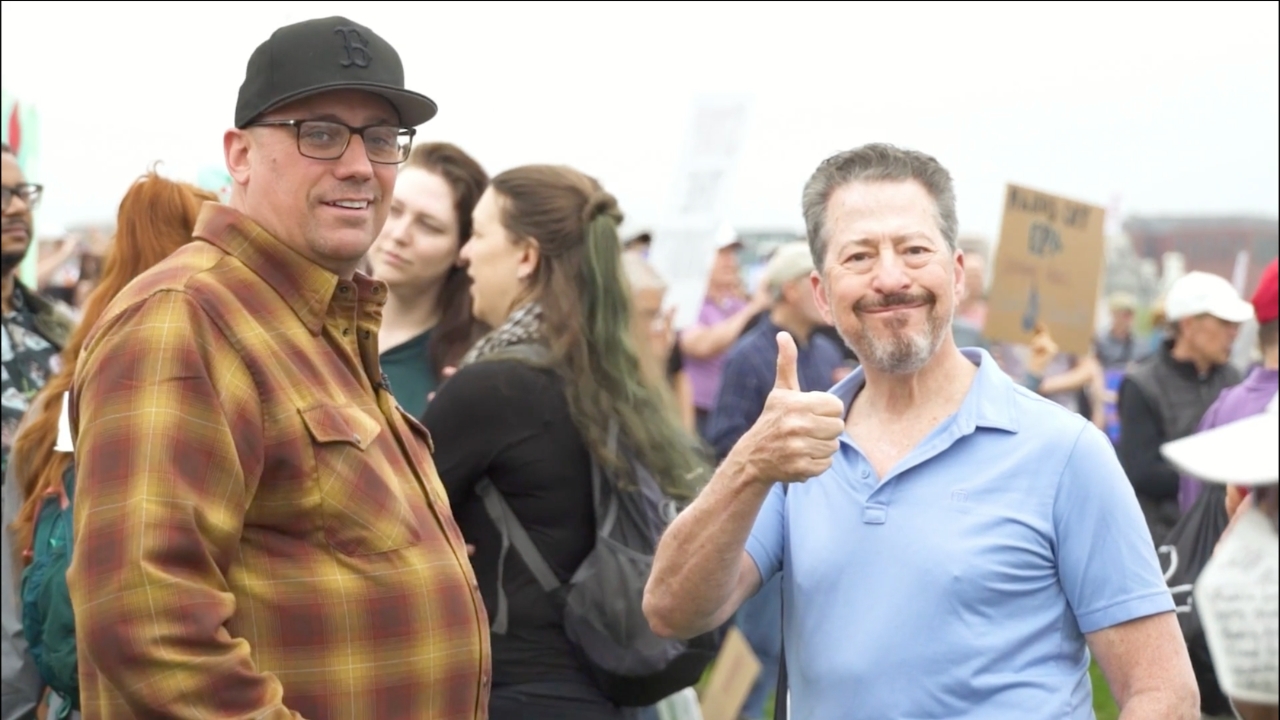
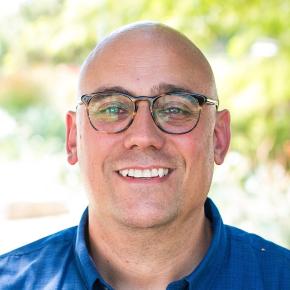
Jon Noyes talks to a protestor at a women’s rights march who believes human value is founded in pragmatism and social constructs. In response, Jon argues that human dignity is grounded in something much higher—the image of God.
Transcript
Jon: Do you think it’s a social construct that lends value to people? Like, if the social construct changes, does the value of the person change?
Protestor: That’s a great question because….
Jon (commentary): As you watch this video, notice how I open with a public health discussion, but I pivot really quickly into a foundational question: Why are human beings valuable?
Keep in mind, I’m always trying to dig deeper. And we can use any launching-off point, by the way. Here it’s public health. And my partner in the conversation offers a range of options. He says natural law and social contract, and he even alludes to some Buddhist views and pragmatism, but then I press him into whether these provide a stable foundation for what he actually believes.
Notice the tactic to pull out is, again, question asking. This is Columbo 101. Why do people have value? Ask the question, and wait for them to answer. The conversation is highly political, but I’m trying to skip beyond the political complaint, and I’m trying to get to the moral grounding. And that’s one of the things that I love about politics in general. They’re all moral claims—political claims are. I’m seeking to clarify definitions by asking questions. Is human value a social construct, or is human value an objective fact?
Let’s watch the video.
Jon: Can I ask you a question about—my name is Jon, by the way.
Protestor: Alan.
Jon: Good to meet you, too.
I don’t necessarily—I probably don’t agree with a lot of people here. I’m from Southern California, so I’m an oddball there, too. Why do you think this is—like, [I see] a lot of signs about democracy and a lot of signs about human rights. Why do you think that’s important? What’s important about democracy? What’s important about human rights?
Protestor: I’ll ask you, what do you think is important about human rights? Or not human rights. What do you think is important for democracy, or what’s necessary for a democracy?
Jon: Yeah. Absolutely. I think a democracy, inherent in the system of government, values the individual. So, there should be preventative measures within a democracy [to prevent] taking advantage of the everyday person because I think people are valuable. So, that’s where, I guess, my question goes. Would you agree with that?
Protestor: Absolutely.
Jon: What makes people valuable? Why is public health for children—and the answer seems obvious when you ask it, but if we really think about it, I’ve asked it now a half dozen times to people, and one guy called me a Nazi, and one person just yelled at me and walked away. I had a good conversation with somebody earlier.
Protestor: Well, I’ll ask you. Does each individual person have their own individual value?
Jon: Well, that’s the question. Yes, I think it does. How about you?
Protestor: I believe so, too.
Jon: Where does that value come from?
Protestor: People call it a natural law. People would call it the difference between the cognizant, the sapient, and the non. And you can go all the way to a Buddhist perspective, where every atom is actually sentient and every worm has value, or you could take it to another value where it doesn’t matter. Deep space and deep time. For society to work, and for there to be, hopefully, the reduction of pain, poverty, and suffering, each aspect of the person is given a value, and no one is more valuable than the other. So, with that agreed-upon social construct, that prevents mass murders. That prevents overarching tyranny. And to me, that’s where that comes from.
Jon: You said something that’s interesting to me. You mentioned a bunch of different worldviews, but then also you said in there the social construct, right? Do you think it’s a social construct that lends value to people? Like if the social construct changes, does the value of the person change?
Jon (commentary): Did you guys notice how quickly the conversation turns from political to worldview? Well, that’s because ultimately every political debate is grounded in a view of the human person. It’s moral in nature. And I expose this by simply asking, why are people valuable? And the person I’m having the conversation with, he offers a kind of a grab bag of answers: natural law, Buddhism, social constructs, pragmatism. He kind of throws all of those out. But he’s combining competing worldviews without realizing it.
If human value is just a social construct, then value can shift with the society, and we’ve seen where that leads. Right? We’ve seen that lead to things like slavery and genocide and oppression. The reason we know these things are wrong, regardless of cultural consensus, is because human dignity is grounded in something much higher than social constructs. It’s grounded in the image of God. If human value is a social construct, then it can be deconstructed. But if it’s grounded in God, it can’t be touched.
Here, I want you to see that I bring up the Nuremberg trials, and I use them to make a really powerful point about objective moral law transcending human governments. The conversation here lends, I think, beautifully into the natural law space. And if you’ve taken note of the tactics I use, I want you to see that I’m using real-life examples to show that we all appeal to a higher law.
Ask yourselves the question, why is genocide wrong? Well, it’s wrong regardless of political context, and this becomes clear during the content of the conversation.
Jon: Say this group of people, this size group—this is a lot. This is way more people than I was expecting. Say this group of people got together and decided somehow we were not going to value a certain group of people.
Protestor: That has happened.
Jon: I know it has—throughout history, all the time. It’s horrible because we know that there’s something inherent about human beings that is valuable, independent of cultural thought. Right? So, it’s something that transcends that.
Protestor: Well, actually it should, but that’s a value that you’re espousing and that I agree with, but there are other folks who say no. There are humans who have been viewed as subhuman, and the value was taken from them by the group, or people acquiesced and went along with that.
But that was wrong?
Protestor: From my perspective and likely your perspective.
Jon: Well, and I think it’s not a matter of perspective. I think what Hitler did in Nazi Germany was wrong. Actually, that’s interesting, because—you seem like a really smart guy. Liberation happened. Right? The Allied forces moved in. Nazis dispersed. We hunted them down. We brought them to Nuremberg. Right? The defense that the Nazi war criminals brought before Nuremberg was, well, this is cultural consensus, and the court said no, no, no because there’s a law above that law. Right?
So, that’s what I’m getting at. I think that we’re valuable because I have a grounding for that. I’m a Christian, so I have a grounding for that in the image of God. We’re all made in the image of God regardless of religion, creed, race, whatever it might be. But without that grounding, I don’t think that we have a ground to stand on for any of this. But I think I have a grounding for that. But I think when we get away from that belief in God is where things go [wrong].
Jon (commentary): This section shows one of my favorite tactics. I use the person’s own instincts to make the case for objective morality. When I bring up the Nazi war criminals at Nuremberg, notice that we both agree they were guilty even though the culture at the time within Nazi Germany permitted their crimes and even excused them and thought they were just fine. That exposes a fatal flaw of cultural relativism. You lose the ability to condemn evil if right and wrong are just majority opinion.
So, why were the Nazis guilty? Well, because there’s a law above the law—a higher moral standard that transcends any earthly or worldly government. That’s natural law. That’s God’s law. If morality comes from culture, the Nazis had to be found innocent. But if it comes from God, then justice stands forever.
Protestor: I was a religion major.
Jon: Oh, great. Okay. Where’d you go to school?
Protestor: I did go to Seminary of Northwestern.
Jon: Oh, great. Great. So, are you a Christian now?
Protestor: No.
Jon: Okay. Why not?
Protestor: Because I’m a Jew.
Jon: Were you a Christian then?
Protestor: No.
Jon: No way. So, what religion were you studying? Was it Judaism?
Protestor: I was studying everything.
Jon: Okay. So, world religions?
Protestor: Well, the concept was phenomenology of religion. World religions are used for power structures that have nothing to do with the original thought that brought the word to be and the relationship of the unknowable.
Jon: So, but being a Jew, you agree with me that there’s a grounding. We’re grounded in the image of God, right? Genesis 1.
[Protestor waves at cameraman.]
Jon: That’s Greg.
Protestor: Is that one of your guys?
Jon: Yeah. He’s my only guy there.
Protestor: There’s no question that that rolls into the entire fundamental Judeo-Christian background. And it even goes further than that. It goes to the noetic principles. I mean, you go to Zoroaster. We can go way, way back. But yeah, agree.
Jon: But you abandon that. It sounds like we agree. This is—wow.
Jon (commentary): This is another classic worldview clash. My conversation partner here believes that all religions are basically the same—different cultures telling different stories about the same God. Something we probably hear all the time. But that’s simply just not true. The core claims of Christianity, Islam, and Judaism directly contradict each other. Jesus can’t simultaneously be the crucified Messiah, a failed false prophet, and a prophet who died and then was raised again. They can all be false, but they can’t all be true. And that’s the basic logic here. Religious pluralism often sounds humble, but in reality, it dismisses the actual claims each religion makes. All roads don’t lead to the same place when they’re headed in opposite directions.